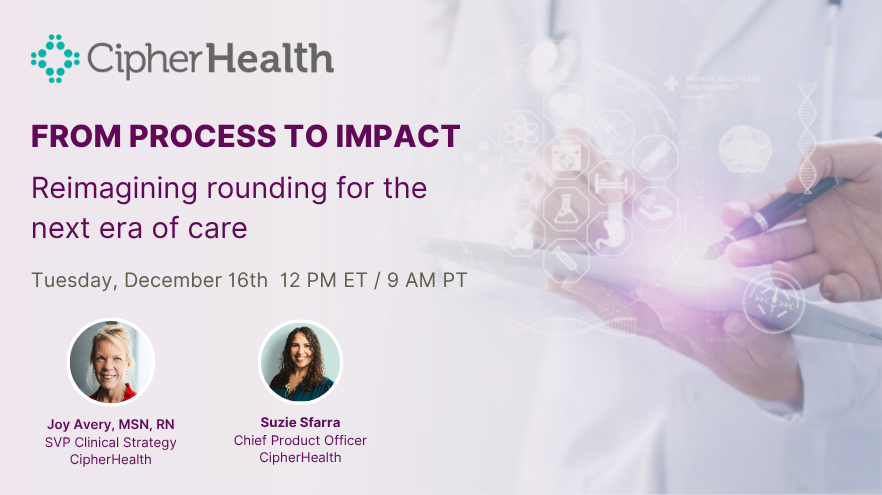


During a recent webinar, From process to impact: Reimagining rounding for the next era of care, attendees were polled on their biggest obstacles with leader rounding today. Their response? Time was the greatest constraint, followed by inconsistent patient follow-up and difficulty measuring impact.
At many organizations, these issues have inevitably led to “check-the-box” rounding that often fails because it focuses on logistics instead of relationships.
In this recap, we’re looking ahead to technological advances like predictive prioritization, ambient listening, and richer patient insights and how they are making care better for both patients and staff.
The result is a more purposeful model of rounding, one that fits into daily workflows, helps teams focus on the patients who need them most, and centers meaningful connection over compliance. Ultimately, the future of rounding is one based in trust.
Moving from activity to purpose
For years, rounding has been measured by activity. “Did you round on five patients today?” The question’s focus is on volume and compliance, at the expense of connection and outcomes.
As Joy Avery, MSN, RN, SVP Clinical Strategy at CipherHealth explained, “We’re not just talking about rounding as a task,” she said. “We’re moving that from process to impact.”
Instead of asking how many rounds were completed, leaders need to ask what changed as a result. Were issues resolved? Were concerns addressed? Did the interaction build trust?
If not, leaders risk falling into what Avery called “whack-a-mole rounding.” Over time, that disconnect shows up as lost trust, increased administrative burden, and growing frustration for staff who already feel stretched for time. This, in turn, leads to attrition.
Moving from process to impact means redefining the purpose of rounding itself, which should be about outcomes over the action itself. Doing so will not only improve relationships and outcomes, but goes a long way towards fostering patient trust.
The trust gap
Research from the Beryl Institute underscores the need for health to restore patients’ sense of trust. Ninety-two percent of patients say trust is extremely important, but only 35% report having high trust—a 56-point gap. As Avery said, “We are in a trust crisis.”
And when trust breaks down, clinical quality suffers. Avery pointed to additional data from the Advisory Board linking distrust to a 4% increase in mortality, higher emergency department utilization, and more hospital admissions. It also contributes to lower medication adherence, fewer preventive screenings, and an increased likelihood of tension and violence directed toward care teams.
The “Golden Hour” of service recovery
CipherHealth’s data reveals that when patients identify opportunity areas during rounding, they consistently give lower Top Box scores across experience domains. In other words, patients are telling us something in real time. The question is whether action follows while they are still within the four walls of the hospital.
In order to improve their experience, what matters most is speed. Indeed, the same data shows that when teams respond within the one- to two-hour trust recovery window, referred to as the golden hour, patient experience scores improve across key domains.
4 core objectives of purposeful rounding
A purposeful round is designed to create a meaningful, two-way conversation and ensure follow-through while the patient is still in care. It’s not about rushing through a script or completing a form. It’s about being present, listening carefully, and responding in ways that patients can feel.
At its core, purposeful rounding:
- Centers patient voice: Prioritizes what matters most to the patient in that moment, rather than completing a checklist or hitting a volume target.
- Personalizes the interaction: Incorporates individual needs, social context, and SDOH and DEI considerations to create a more meaningful connection.
- Enables real-time recovery: Identifies and addresses issues while the patient is still in care, accelerating trust recovery and improving experience and outcomes.
- Relies on interaction, not observation: Moves beyond visual checks, as interactive rounds are associated with higher Top Box scores across 7 of 10 HCAHPS domains.
Indeed, other organizations are reframing their approach to rounding around these principles.
At Carilion Clinic, leaders reimagined rounds as “visits,” shifting the emphasis from volume to connection. The result was a 70% reduction in complaints and a 50% reduction in grievances, along with higher leader visit reach (moving from 60% to over 80%).
Providence also moved away from quantity-based goals toward purposeful leader “visits,” which led to 77% Top Box scores, and patients who recalled a visit rate the hospital (vs. 41%) and 13 of 14 units improved visit quality scores.
How rounding will evolve in 2026
Suzie Sfarra, Chief Product Officer at CipherHealth, outlined how technology will play a critical role in making purposeful rounding easier and more effective in the years ahead. Technology should act as a co-pilot, supporting leaders in their work without becoming a barrier to human connection. And AI will help prioritize where leaders spend their time.
New workflows will include:
- Pre-round: AI will flag who needs a round right now based on real time risk factors
- During the round: Ambient listening will capture the clinical content and sentiment without the need for typing, allowing the nurse to be fully present
- Post-round: AI will create a summary of the patient’s preferences, concerns and history, which can be used by the next leader or team member to better understand the patient
At the end of the day, these advances reduce cognitive load, accelerate trust recovery, and help care teams focus on what matters most: meaningful patient conversations.
To see how CipherHealth is bringing these capabilities to life, watch the full webinar or request a personalized demo.