

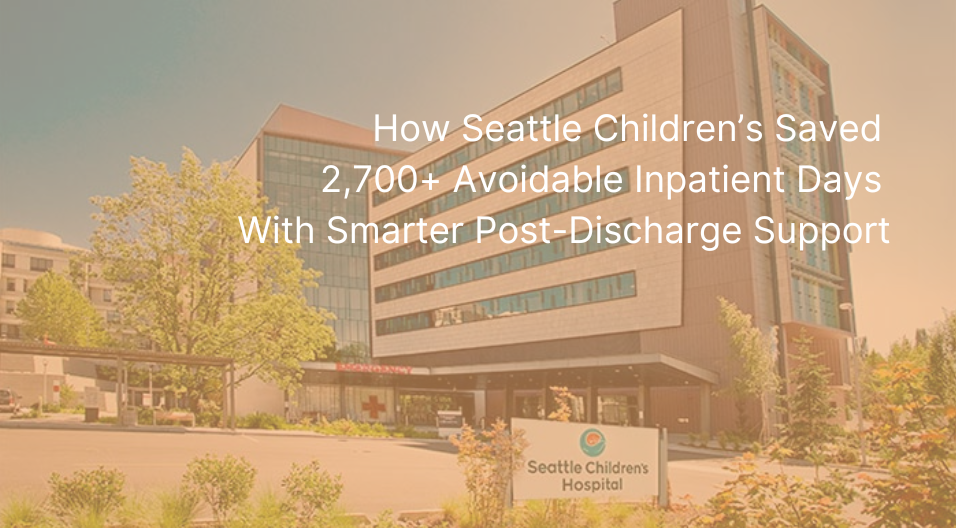
Back in 2014, Seattle Children’s Hospital launched a system-wide effort to strengthen post-discharge outreach and give care teams better visibility into issues that might arise once patients and their families left the hospital.
The organization cares for some of the most complex pediatric patients in the Northwest, serving families across Washington, Alaska, Idaho, and Montana, making effective follow-up an essential part of safe recovery.
Early on, the team learned just how critical that follow-up was: patients who didn’t receive a call were 2.4 times more likely to be readmitted. While the clinical impact of outreach was clear, the challenge was ensuring every family received timely outreach without overwhelming staff.
Today, Seattle Children’s is experiencing the benefits of the work they’ve done over the past decade. What began as a readmission initiative has become a core quality metric, consistently performing at industry-leading levels while delivering financial and operational benefits.
Why Manual Outreach Wasn’t Enough
Before adopting digital tools, Seattle Children’s relied on a single transitional care nurse to manually call patients after discharge. These calls made a meaningful difference for the families, but one nurse simply couldn’t contact every patient.
Reaching all patients would have required significant staffing increases, and the care team needed a solution that could scale without adding workload.
“We needed to make sure families had safe transitions from hospital to home and into the community,” said Anu Asnani, MPH, CHES, Program Manager III, Care Management & Patient Flow.
How Automated, Multilingual Outreach Created a More Scalable Model
Seattle Children’s implemented CipherOutreach in 2018 as part of its broader readmission reduction strategy.
Initially, automated calls were in English and Spanish. This quickly expanded to Vietnamese and Somali after the team identified higher readmission risks among families speaking those languages.
“I’m most proud of being able to reach families in their primary language. Having an automated system that’s streamlined and efficient has been amazing,” Asnani said.
The program combines automation with clinical oversight:
- Automated calls initiate outreach and assess whether a child may need follow-up care
- Additional call attempts and a text message help ensure contact with harder-to-reach families
- Any clinical concerns are escalated directly to a nurse
- Routine issues are routed to non-clinical care coordinators
- Four Transitional Longitudinal Care (TLC) nurses rotate responsibility for escalated cases
Standardized CipherHealth scripts guide each call, reducing the variation in language and improving consistency across Seattle Children’s outreach program.
“CipherHealth has been so engaged in helping us continuously improve the program,” Asnani said. “It makes it very easy to keep advocating within our organization to expand and sustain it, while minimizing gaps in care.”
The Results That Made the Value of the Program Clear
Between January 2023 and December 2024, Seattle Children’s program saw improvements in multiple areas: patient engagement, readmissions, and cost savings:
- 36% reduction in pediatric readmissions
- 2,700+ inpatient days avoided
- 72% engagement rate on clinical questions
- $6.9M estimated annual savings
For Seattle Children’s leadership, the takeaway is loud and clear: when something works, invest in it.
“Healthcare is under a lot of pressure to perform financially,” said Andrew Mullenix, MHA, BSN, NE-BC, FACHE, Sr. Director, Hospital Operations. “When you’re performing really well, it’s easy to lose focus and cut the very resources that make you successful. You have to stick with what’s working, while continuing to advance and improve. It doesn’t take more than a couple of avoided readmissions to show the value and ROI.”
With CipherOutreach, Seattle Children’s has measurably reduced readmissions, supported safer transitions home, and protected its financial stability, saving millions each year. Families also gain confidence knowing their child’s care continues beyond the hospital walls.