
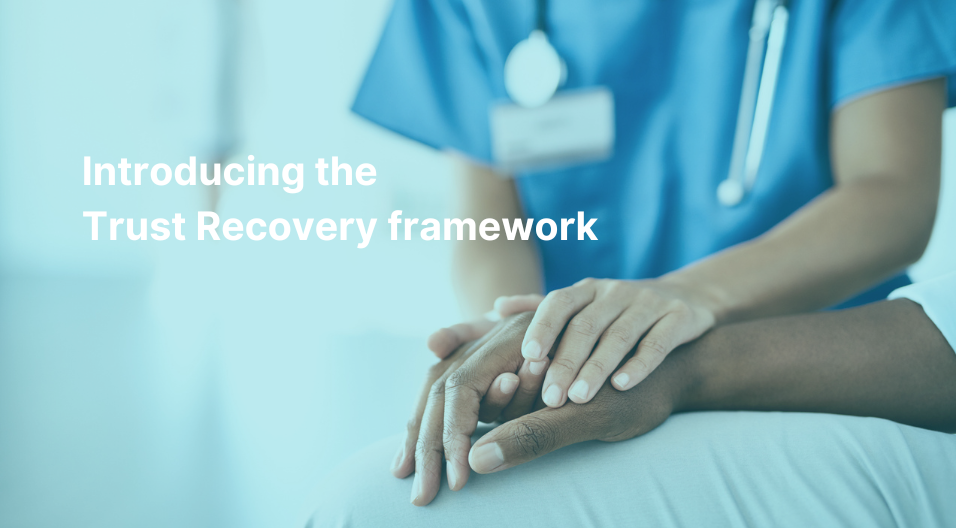
When patient trust is broken, fixing a service issue like the food was cold, the wait was long, the medication was late, isn’t always enough. CipherHealth’s research has found that trust repair requires an intervention, not just a service gesture.
To guide health systems on how to respond and restore patient confidence, our experts have created the “Trust Recovery framework,” which distinguishes trust recovery from traditional service recovery. It introduces the Golden Hour, the first hour after a patient issue arises, as a critical window.
To explore the nuances of how patient trust breaks down, why speed matters, and what this framework looks like in practice, we spoke with Joy Avery, MSN, RN, SVP of Clinical Strategy, about how leaders and clinicians can put trust recovery into place within their organization.
Q: How do you define “trust recovery” in a healthcare setting? And how is it different from simply improving patient satisfaction?
Trust recovery is about rebuilding a patient’s confidence when care falls short of expected standards. This might include situations where the care provided is not evidence-based or does not fully address what the patient needs.
It’s distinct from patient satisfaction. Here’s why: It’s possible to have a satisfied patient who still doesn’t trust you. Satisfaction doesn’t guarantee patients will follow discharge instructions, take medications, or return for care. Trust does.
The framework captures this well: satisfaction is transactional, but trust is relational. The difference between a satisfied patient and a loyal one is whether trust has been restored.
Q: What is the difference between trust recovery and service recovery?
Service recovery is what most organizations are familiar with or what is ingrained in their current culture. It’s about fixing process issues; you correct them and move on.
Trust recovery goes deeper. It tries to address emotional and relational harm when patients feel their confidence in the care team has been broken.
If a patient says, “My food was cold,” that’s a service issue. If they say, “No one seems to be on the same page about my care,” that’s a trust issue. Fixing it requires listening, acknowledgment, alignment with the care team, and follow-through.
Q: Where do you most often see trust breaking down for patients?
A key trigger is when a patient feels depersonalized, like a number instead of an individual. This perception can erode trust faster than isolated service failures.
Communication gaps are another trigger, especially when teams aren’t aligned, and patients receive conflicting information.
Furthermore, silence can be just as harmful as errors themselves and can quickly turn concern into distrust.
Over time, all of these triggers widen the gap between the trust patients want to feel and what they actually experience during care. Consider that 92% of consumers say trust is extremely important to their healthcare experience, yet only 36% report high trust, as per The Beryl Institute PX Pulse consumer research.
Q: Why is speed so critical to trust recovery, and what happens when response is delayed?
This is where the “Golden Hour” concept comes in. We borrowed this idea from emergency medicine: the first 60 minutes after something goes wrong are absolutely critical because emotions are at their peak. If you acknowledge the issue right away, even before you have the full solution, you signal that you’re paying attention, that this matters, that the patient matters.
Immediate acknowledgment of an issue demonstrates that you are engaged, that the situation is taken seriously, and that the patient’s needs are valued—even before a resolution is reached.
Never underestimate the power of simply telling someone, “I get it, and I’m on it.” Validating their concerns and pivoting straight to a solution is the fastest way to turn a skeptic back into a believer.
Q: What role should nurse leaders play in trust recovery, and how does purposeful rounding enable that role?
Nurse leaders are really the linchpin here. They’re the ones who can train their teams to recognize when something is a trust issue versus just a service issue. They set the tone, model behavior, and create the escalation pathways when things can’t be resolved on the spot.
Purposeful rounding makes this operational by turning routine check-ins into intentional trust-building moments. Asking ‘What matters most to you?’ changes the interaction from a clinical transaction to a human connection. It turns a standard round into a trust-building moment.
Q. Why does trust recovery matter at the health system level, not just the bedside?
Trust is a strategic imperative. According to The Beryl Institute’s State of Human Experience research, more than 80% of healthcare leaders now treat experience as a core priority. Trust also affects reputation, market share, financial performance, and malpractice risk.
But what’s often overlooked is the workforce impact. When clinicians are disconnected from patients, moral distress and burnout rise.
According to The Beryl Institute, 35% of organizations cite caregiver burnout as a barrier to experience goals today, which can be driven by a lack of meaningful connection. Trust recovery helps restore that human connection.
Q: How should health systems incorporate trust recovery into their processes? What about their vocabulary?
On the process side, the framework lays out a practical roadmap. You start by educating leadership and champions, aligning teams on how to recognize trust issues versus service issues, and embedding a one-hour loop closure standard into rounding workflows.
From there, you pilot on a few units, create escalation pathways for tougher situations, and begin tracking “Golden Hour” responses in shift huddles.
By month two, the approach is rolled out more broadly, with “Golden Hour Wins” recognized publicly to reinforce the behavior.
By month three, leaders review metrics and refine the approach.
On the vocabulary side, this is about shifting culture. Instead of saying purposeful rounding is about “catching issues,” you frame it as a connection, not a correction. The focus is on fostering trust, beyond patient satisfaction. When approached this way, these practices are not soft skills—they are essential strategies for clinical safety.
As I often say, “We can’t always fix the system, but we can fix the experience.” That gives frontline staff permission to focus on what they can control: the relationship.
Q: How can you set goals and measure progress around trust recovery?
Measurement requires both process and outcome metrics. On the process side, track time to first acknowledgment, with a goal of responding to 80% of issues within 60 minutes.
On the outcomes side, focus on HCAHPS domains tied to trust (communication, responsiveness, and teamwork) with a target of three to five percentile-point improvement within six months. Clinical outcomes like falls, pressure ulcers, and medication adherence should also improve if trust is the driving behavior.
Finally, monitor workforce metrics such as engagement and turnover. When trust recovery works, it shows up not just in patient outcomes and loyalty, but in staff connection and sustainability.
What makes this approach powerful is that it allows trust to be measured. Instead of relying on assumptions, you can track whether the right behaviors are taking place and whether they are truly improving the patient loyalty and trust.
To learn how your health system can operationalize trust recovery, speak with our experts.