
Improving infection prevention compliance with CipherRounds
CipherRounds helped a large health system hit 90%+ infection prevention compliance, cut SIR 35%, and boost hand hygiene observations 80%.

Over a two-year period, the health system used CipherRounds to drive measurable improvements in rounding volume, bundle compliance and infection prevention, ultimately reaching or surpassing the system-wide 90% compliance goal across all three focus areas.
35%
reduction in Standardized Infection Ratio (SIR)
90% +
in Foley bundle, central line, and hand hygiene compliance
80%
increase in hand hygiene observations
Background
Each year, an estimated 2 million patients in the U.S. acquire healthcare-associated infections (HAIs), leading to nearly 90,000 deaths and costing hospitals between $28 and $45 billion.1
A leading nonprofit healthcare provider in Northern Virginia and the Washington, D.C. area, delivers care to over one million patients annually across five hospitals and a broad network of outpatient, primary, specialty, emergency and urgent care services.
As part of its commitment to infection prevention and quality improvement, the health system used CipherRounds to boost rounding volume and compliance for Foley catheters, central lines and hand hygiene. By standardizing scripts, improving data transparency and building stronger unit-level ownership, they made it easier for staff to assess care practices and see how their efforts were driving measurable progress.
Challenge
Before adopting CipherRounds, the health system’s infection prevention rounding process lacked alignment across teams. Nurse leaders and infection preventionists followed different scripts—one lengthy and click-heavy, the other too brief for meaningful comparison. This made it difficult and often confusing to analyze data, identify trends or understand why compliance rates differed.
At the same time, the organization had set a system-wide goal of reaching 90% compliance across key infection prevention bundles. But without consistent language, teams lacked the clarity needed to measure progress or understand where to focus improvement efforts.
Solution
With CipherHealth, the team redesigned its rounding process to make best practices easier to follow and track. Scripts for Foley catheters and central lines were streamlined into a single evidence-based question per device, using uniform language across both infection preventionists and nurse leaders. This helped staff set clear expectations and compare “apples-to-apples” results across teams more reliably.
Staff feedback played a key role in refining these scripts. Education ensured that regardless of role or experience level, everyone understood what to look for, how to interpret the script questions and document accordingly.
In addition, hand hygiene rounding moved from a legacy system into CipherRounds, bringing all rounding efforts together on one user-friendly platform.
Further, the health system improved how and when results were shared. What was once an annual or quarterly report is now reviewed monthly, giving teams quicker access to performance trends and compliance gaps.
Through their coordinated efforts, the organization supported long-term behavior changes tied directly to infection prevention goals.
Results
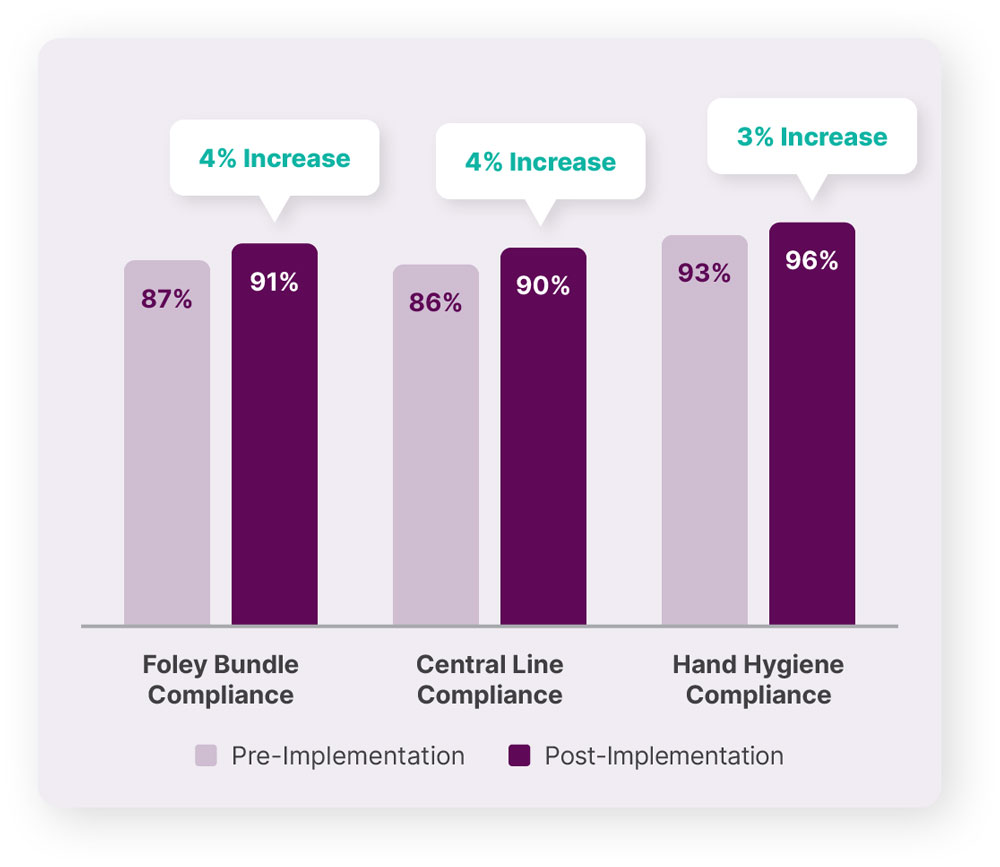
Over a two-year period, the health system used CipherRounds to drive measurable improvements in rounding volume, bundle compliance and infection prevention, ultimately reaching or surpassing the systemwide 90% compliance goal across all three focus areas:
Foley:
- 47% increase in total rounds (from ~30,000 to ~44,000).
- 4% increase in bundle compliance, from 87% to 91%.
- 35% reduction in Standardized Infection Ratio (SIR), supported by standardized rounding and nurse-driven Foley removal protocols.
Central Line:
- 37% increase in total rounds.
- 4% increase in compliance, from 86% to 90%, though SIR increased, suggesting other contributing factors are at play, such as patient acuity and line utilization trends. Still, it remained below 1.0 throughout this period.
Hand Hygiene:
- 80% increase in observations.
- 3% increase in compliance, from 93% to 96%, driven by a strong culture of accountability and supported by alignment with Leapfrog safety requirements.
The changes didn’t just improve the numbers. They helped build a stronger culture of accountability. One pediatric oncology unit maintained 100% rounding and made CLABSI prevention its top goal. While this team had long been diligent, they previously had little visibility into how their efforts contributed to system-wide goals. With more transparent data sharing, they could finally see the impact.
Want to become the next success story?
Schedule a demo and see how CipherHealth can deliver results for your organization.