
What does effective patient outreach look like and how do you scale it without adding more work to overstretched teams?
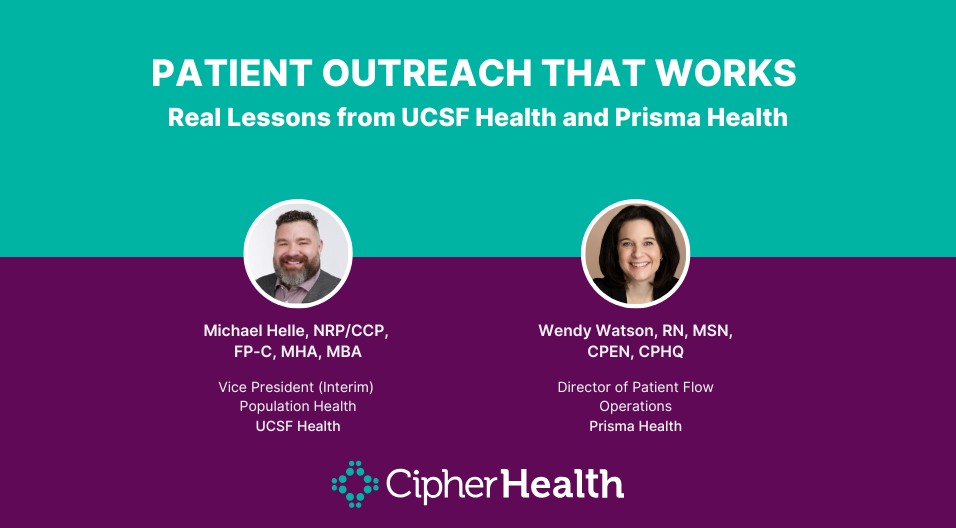
In our recent webinar, leaders from UCSF Health and Prisma Health shared how they’re combining automation, clinical insight, and centralized teams to stay connected with patients after discharge.
Here’s the behind-the-scenes on how they are successfully reaching more patients.
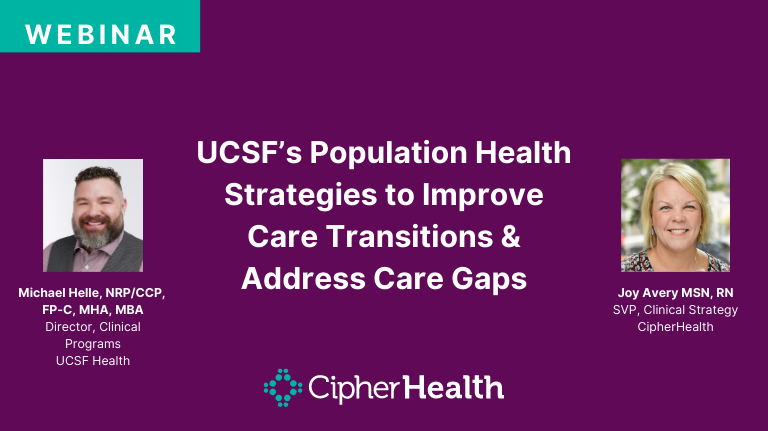
UCSF Health: Reducing cost and expanding reach with nurse-led automation
About ten years ago, UCSF Health created a dedicated Population Health department to unify outreach efforts across clinics and hospitals. That team now runs three programs focused on post-discharge support, 30-day longitudinal monitoring, and care gap closure.
At the time, discharge calls were resource-intensive—costing the system roughly $82 per call.
“FTE resources are becoming harder to obtain,” said Michael Helle, NRP/CCP, FP-C, MHA, MBA, Vice President (Interim) Population Health, UCSF Health.
“We really have to take advantage of how we can automate a lot of the work we’re doing to target those patients that really need to have assistance from a physical human being,” he said.
Instead of relying on staff to manually place thousands of calls, UCSF built structured, nurse-led workflows—with triage protocols, social work support, and tailored scripting—that reach patients faster and more consistently.
The cost per call has since dropped to just $2. According to Helle, the technology has expanded their outreach capacity “almost by 8 fold,” giving patients a one-touch path to the right resource.
Prisma Health: Fast follow-up and actionable data at scale
Prisma Health, South Carolina’s largest nonprofit health system, built a scalable outreach model that combines automation with real-time nurse triage across 19 hospitals.
Since launching CipherOutreach in late 2023, they’ve reached more than 615,000 patients through calls and texts. When a patient flags a concern—like a new symptom or medication question—they’re quickly connected to a nurse. That fast response is central to the program’s success.
What began as standard follow-up is expanding into diagnosis-specific outreach for conditions like heart failure and stroke. These efforts are informed by detailed dashboards that help the team sort data by location, demographics, or length of stay.
Seeing those insights in action, said Wendy Watson, MSN, RN, CPEN, CPHQ, Director of Patient Flow Operations, Prisma Health, “reignited our excitement around this project and what we’ve been able to accomplish.”
She added, the only “problem” with CipherHealth is that her teams are asking when it can serve their areas. “Everyone wants to be part of it.”
One platform, many possibilities
At Prisma Health and UCSF, outreach is built to engage patients meaningfully and respond in real time. It’s about using data and technology to proactively connect with patients, catch issues early, and use staff time wisely.
As CMS rolls out new payment models and tightens readmission penalties, health systems that proactively support high-risk patients will be better equipped to improve outcomes and control costs and CipherHealth makes it possible.